
H. pylori Infection: Tests, Treatment and How Vonoprazan Helps
How H. pylori is found and treated, why strong acid control helps the antibiotics work, where vonoprazan (a P-CAB) fits, and why you need a test of cure.

Helicobacter pylori (H. pylori) is a bacterium that lives in the lining of the stomach. It is common in Malaysia, and most people who carry it have no symptoms. In some people it causes gastritis and stomach or duodenal ulcers, and long-term infection raises the risk of stomach cancer. Clearing it heals ulcers and greatly lowers the chance of them coming back.
In short: H. pylori is confirmed with a breath, stool or biopsy test. Treatment is a combination of antibiotics with strong acid suppression, usually for 14 days. A repeat test at least 4 weeks after finishing confirms it has gone.
Who should be tested?
- anyone with a stomach or duodenal ulcer, now or in the past
- gastritis or a positive biopsy found at gastroscopy (OGDS)
- ongoing indigestion (dyspepsia), especially in younger adults without warning signs
- a parent, brother or sister who had stomach cancer
- people starting long-term aspirin or anti-inflammatory painkillers who have had an ulcer before
- unexplained iron deficiency anaemia
How is it tested?
- Urea breath test: you drink a test solution and breathe into a bag. Accurate and simple.
- Stool antigen test: a small stool sample.
- Biopsy at gastroscopy: often a rapid urease (CLO) test, with the result the same day.
Acid-reducing medicines and antibiotics can hide the infection. Unless your doctor says otherwise, stop PPIs and vonoprazan for 2 weeks, and antibiotics or bismuth for 4 weeks, before a breath or stool test. A blood antibody test only shows past exposure, so it cannot confirm a current infection or a cure.
How is it treated?
No single antibiotic is enough. Doctors combine two or three antibiotics with an acid-suppressing medicine. Common combinations include:
- Triple therapy: an acid suppressant (a PPI or vonoprazan) with amoxicillin and clarithromycin.
- Bismuth quadruple therapy: a PPI with bismuth, metronidazole and tetracycline.
- Dual therapy: vonoprazan with amoxicillin only.
Your doctor chooses based on antibiotic resistance in the area, any penicillin allergy, and what you have taken before. Resistance to clarithromycin has been rising in Malaysia, which is one reason older 7-day triple therapy works less well than it used to. Most courses now last 14 days.
Why acid control matters
Amoxicillin and clarithromycin work best when the stomach is less acidic, and H. pylori is more sensitive to antibiotics when acid is kept low throughout the day and night. Weak or patchy acid suppression is a common reason treatment fails.
Where vonoprazan fits
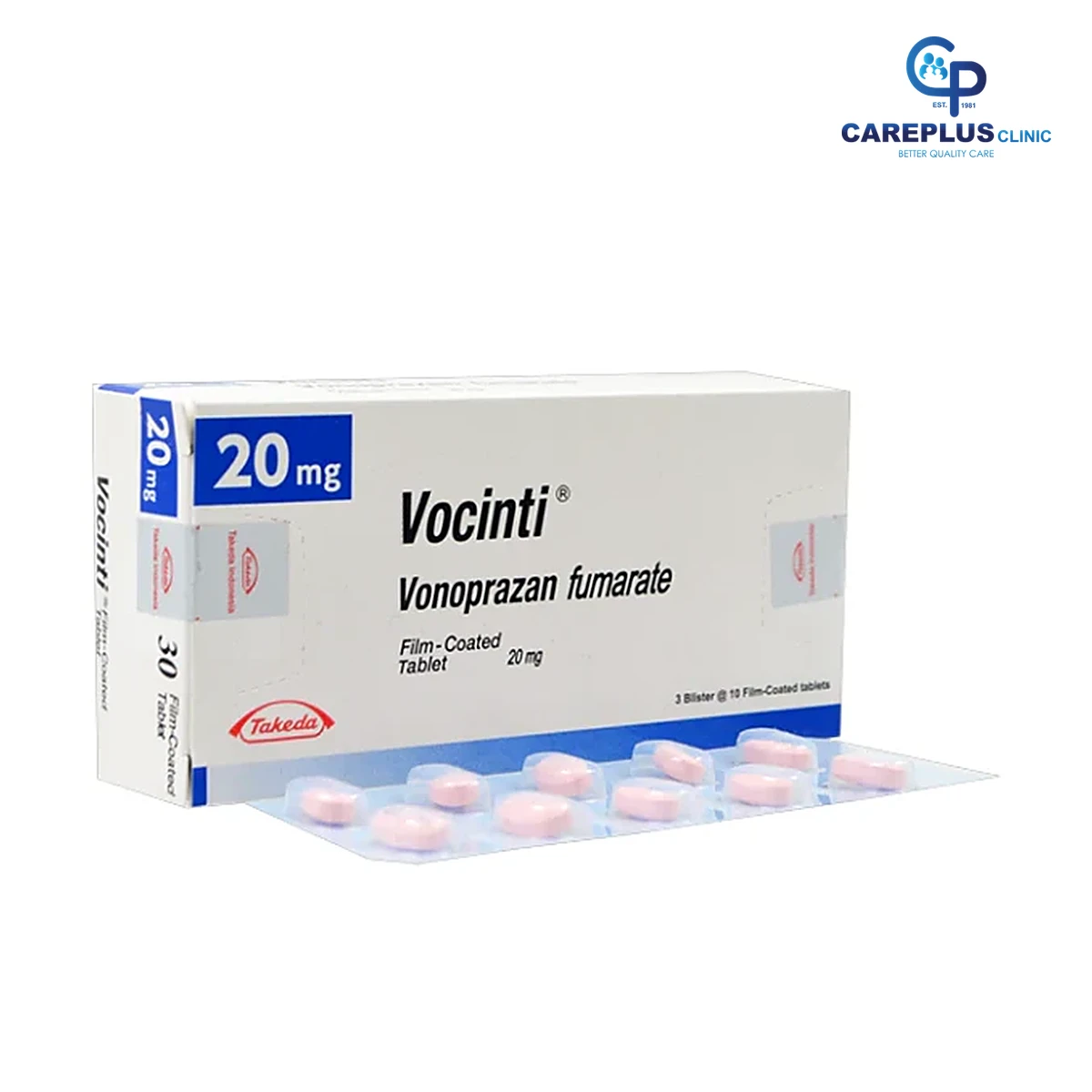
Vonoprazan (for example Vocinti) is a potassium-competitive acid blocker, or P-CAB. Compared with PPIs it:
- works from the first dose and keeps acid low for longer, including at night
- does not need to be taken before food
- works the same in everyone, whereas PPIs are broken down quickly in some people because of the CYP2C19 gene
In clinical trials, vonoprazan-based triple and dual therapy cleared H. pylori at least as often as PPI-based triple therapy, and more often when the bacteria were resistant to clarithromycin. Vonoprazan is not an antibiotic, so it is always used as part of a combination. PPIs such as esomeprazole and pantoprazole remain good options in many regimens. Your doctor decides which suits you.
Taking the course
- Take every dose, usually twice a day, and finish the whole course even if you feel better.
- Common side effects are a metallic taste, nausea, loose stools and bloating. They usually settle after the course.
- Avoid alcohol if your course includes metronidazole.
- Tell the doctor about any penicillin allergy and all other medicines you take.
Test of cure
About 1 in 10 courses fails, so a breath or stool test at least 4 weeks after finishing is recommended, with acid-reducing medicines stopped for 2 weeks beforehand. If the infection is still there, the doctor chooses a different combination rather than repeating the same one.
See a doctor urgently if you have
- vomiting blood or material that looks like coffee grounds
- black, sticky stools
- difficulty or pain when swallowing, or food sticking
- weight loss without trying, or persistent vomiting
- severe or sudden tummy pain, or feeling faint
Related: stomach ulcer: causes and treatment and medicines after a gastroscopy.
Questions people ask
Can H. pylori spread to my family?
It usually spreads in childhood within families, through saliva or contaminated food and water. Adults rarely catch it again after a successful cure. Family members only need testing if they have symptoms or a family history of stomach cancer.
Is vonoprazan stronger than a PPI?
It lowers acid faster and more consistently than standard PPI doses. That helps the antibiotics, but it does not replace them. Your doctor chooses the combination.
Can I take my usual gastric medicine during the test?
Stop PPIs and vonoprazan 2 weeks before a breath or stool test, unless your doctor advises otherwise. Antacids such as Gaviscon are usually fine.
Sources
Get it from CarePlus Clinic
 13% OFF℞ Prescription
 15% OFF℞ Prescription
 18% OFF℞ Prescription